


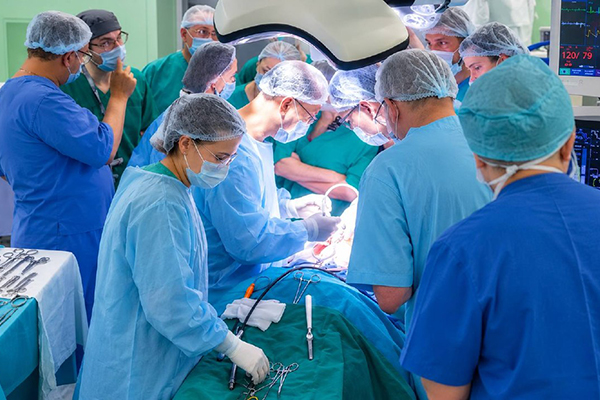
The patient is 38 years old. In 2022, he suffered a shrapnel wound to the spine with spinal cord injury at the thoracic region. As a result, movement and sensitivity below the injury site were impaired. With mine-explosive and fragmentation injuries, an extended destruction zone with scar tissue and cysts can form. It is not yet possible to restore conduction through such a site in case of chronic complete injury using standard methods.
This is the problem that allotransplantation of the vascularized spinal cord segment is designed to solve. The damaged tissue is removed to the remaining areas, and the resulting defect is replaced with a donor segment. It is transplanted along with the vessels and the blood supply is restored. Thus, the graft should become a kind of "bridge" between the preserved parts of the spinal cord.
Employees of Pirogov University participated in the work: the ideologists of the operation and its organizers were the head of the Department of Plastic, Reconstructive Surgery, Cosmetology and Cellular Technologies at the Institute of Continuing Education and Professional Development (INOPR) of Pirogov University, chief freelance specialist plastic surgeon at the Ministry of Health of the Russian Federation, Corresponding Member of the Russian Academy of Sciences Natalia Manturova and Professor of the same Department Valentin Sharobaro, and also associate professors of the Department of Transplantology and Artificial Organs named after V.P. Demikhova Institute of Biomedicine (MBF) of Pirogov University Aslan Balkarov and Boris Yaremin. Vladimir Krylov, Head of the Department of Fundamental Neurosurgery at the Institute of Neuroscience and Neurotechnology (INN) of Pirogov University, Chief freelance neurosurgeon at the Ministry of Health of the Russian Federation, Academician of the Russian Academy of Sciences, was present in the operating room.
The Chinese surgeon's technique is based on the GEMINI spinal cord fusion protocol, which was formulated in 2013 by Xiaoping Ren and Sergio Canavero. One of his key principles is to connect the tissues as precisely as possible after crossing the spinal cord with an ultra-sharp microsurgical blade. Polyethylene glycol (PEG-600) is applied to the mapped areas, which helps restore the integrity of damaged nerve fiber membranes and has a neuroprotective effect.
For chronic injuries, the team led by Xiaoping Ren has developed an option with allotransplantation of a vascularized spinal cord segment. It is designed for situations where the damaged area cannot be repaired by simply connecting the preserved tissues. The donor segment is transplanted together with its own vascular pedicle, which allows to restore its blood supply.
The transition to surgery in humans was preceded by many years of research. The approach has been studied in several animal species, including large animals and primates. Separately, the transplantation of the donor segment was practiced with restoration of blood supply and subsequent immunosuppressive therapy. Subsequently, clinical trials of other variants of the GEMINI protocol in patients with complete paraplegia were conducted in China. The obtained results have shown the fundamental possibility of applying the approach in humans.
As Natalia Manturova emphasizes, the performed operation is not a separate experimental episode, but the next stage in the development of reconstructive transplantology.
"We were moving towards this gradually: first, upper limb allotransplantation began in Russia, and now we have performed the first spinal cord segment allotransplantation operation. This is a logical continuation of one direction — reconstructive transplantology.
At the same time, it is important that this area in Russia does not remain a single episode, it is not just a separate surgical success.: we are trying to develop it together with our colleagues from China — we are forming groups of residents and sending them to study in China so that the methodology can be mastered and improved on the spot," said Natalia Manturova.
Now the next important stage begins — long-term monitoring and rehabilitation of the patient. The result of such an operation cannot be assessed immediately: specialists will monitor motor and sensory functions, conduct neurophysiological studies and MRI with diffusion tensor tractography, evaluate the work of the autonomic nervous system and other indicators.
In parallel, the development of the direction itself continues. As part of international cooperation, Russian residents undergo a six-month internship in order to master and improve the new methodology.
"I am sure that with such consistent work — from pre—clinical to the training of residents and international cooperation — this area has a great future in Russia,"Natalia Manturova emphasized.
Thus, the performed intervention was the result of a long—term path - from preclinical research and development of surgical technology to international cooperation and the first clinical allotransplantation. Further monitoring of the patient will allow us to assess the possibilities of the new approach, and the training of specialists will create the basis for its further development in Russia.