


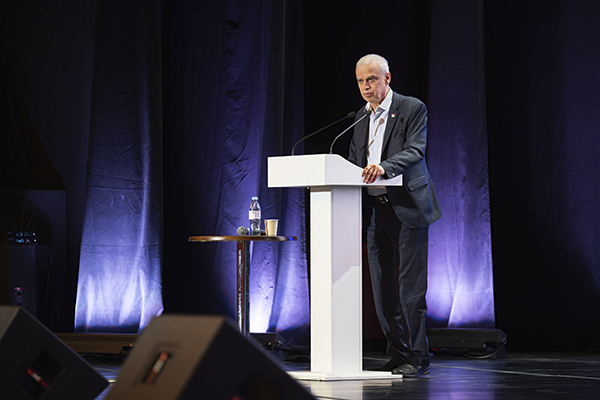
Sergey Lukyanov, Rector of Pirogov University, dedicated his speech to the connection between fundamental science and practical medicine. At the Fundamental Library of Moscow State University, he gave a lecture "The Universe of Biomedicine: from new knowledge to new treatment strategies," in which he spoke about the mechanisms of aging, the immune system and the search for solutions that can improve people's quality of life.
The rector explained why aging cannot be reduced to a single process: different body systems can change at different rates. He paid special attention to immune memory, age-related changes in defense mechanisms, and the reasons why immune cells begin to attack their own tissues. Using the example of autoimmune diseases, Sergey Lukyanov showed how difficult the path to effective therapy is and why it requires a deep understanding of cellular processes. One of the key thoughts of the lecture was the need to turn fundamental knowledge into real help for a person: the search for answers to the questions of aging should be accompanied by work on specific diseases today.
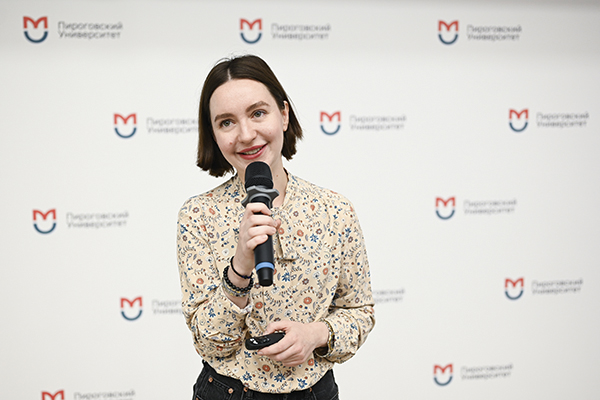
The topic of health preservation was continued on the site of Pirogov University — in a conversation about space medicine. The lecture "Expedition to longevity: how space flights teach us how to deal with aging" was conducted by Lyubov Machekhina, PhD, Head of the Laboratory of Biomarkers of Aging at the Russian National Research Center, Endocrinologist. The meeting took place on the site of the student scientific circle of Gerontology and Geriatrics of the Department of Diseases of Aging of INOPR.
The audience learned why observations of an organism in zero gravity are of interest to researchers of age-related changes. The weakening of muscles and a decrease in bone mineral density with a lack of exercise make it possible to study processes similar to those that occur during aging on Earth. One example was the study of twin brothers Scott and Mark Kelly: while one was on the ISS for almost a year, the other stayed on Earth. A comparison of their health indicators, including changes in the length of telomeres — protective areas at the ends of chromosomes — helped to show the complexity of the body's response to the space environment. The discussion was also devoted to the practical significance of such work: the search for approaches to the prevention of age-related diseases and the preservation of physical activity.
The guests were able to see how scientific and engineering solutions are changing the daily work of a doctor at two lectures on surgery. At the meeting "Space surgeon: robots, AI, training", the principles of the da Vinci system, which reproduces the movements of the surgeon and filters the shaking of the hands, were analyzed. The conversation about the prospects of remote operations was supplemented with a story about the training of specialists — training on simulators, mastering tools and assisting experienced colleagues. The students were invited to check the coordination of both hands themselves in a small interactive session.
Practical examples were presented by Artyom Pavlenko, a urologist, oncologist, graduate student of the Department of Urology and Andrology named after Academician N.A. Lopatkin of THEIR Pirogov University. At the lecture "How modern technologies are changing conventional surgery," he spoke about the use of three—dimensional models in planning interventions, ultrasound to search for tumors and determine the boundaries of their removal while preserving the kidney, flexible endoscopes and a laser to crush stones without incisions. Separately, we discussed how a printed 3D model helps the doctor visually explain the upcoming operation to the patient. Both meetings touched upon the possibilities of artificial intelligence in diagnostics, operations analysis and training, as well as the importance of knowledge, practice and teamwork in mastering new tools.
Six young scientists from Pirogov University, participants in the "Scientific Battle", presented their own research tasks. Everyone had ten minutes to explain the essence of their work and interest the audience. The topics of the presentations concerned the treatment of chronic arterial ischemia, the impact of stress on decision-making in emergency care, the diagnosis of periodontal diseases and individual approaches to assessing the condition of patients with diabetes mellitus.
The title of the report, "Glue cannot be sewn on," was an experimental study on the prevention of seroma— fluid accumulation after surgery. It studied how the methods of mesh implant fixation affect the development of complications. Another work was devoted to the sleep patterns of medical students and became the basis for the development of an application for regime adjustment. The format of the "Scientific Battle", in which the winner is determined by audience applause, allowed the guests to get acquainted with research through understandable stories, and young scientists to try their hand at scientific communication.
At Skoltech, the acquaintance with medicine continued in the family quiz "Space as a laboratory". The participants were looking for answers to questions about the effects of weightlessness on the cardiovascular system and vestibular apparatus, as well as about the possibilities of ultrasound diagnostics in orbit and the study of cellular processes. A separate part of the game was dedicated to the expedition of Oleg Atkov, a pilot-cosmonaut, an employee of Pirogov University, to the Salyut-7 station, where he studied the work of the heart and blood vessels, vestibular disorders and human performance. Several rounds required erudition, logic and the ability to reason together from the teams.
Another way to understand the life of an organism in space was offered to the participants of the master class "Anatomy of Adventure: what is this?", which was held at Skoltech in partnership with Pirogov University. Here, scientific questions have become the basis of comics. The heroes of the stories were the organs, cells, and systems of the body that faced the conditions of space flight. The participants came up with a plot, created a storyboard and presented their finished works. They were helped along this path by Dina Sigunova, designer of the exposition and exhibition department, and Maria Belioglova, project manager of the department, a storyteller.
The festival program was complemented by the Pirogov University merch raffle. And the main content of the meetings was a live introduction to science: the guests discussed research with scientists, understood medical technologies, searched for answers in a team game and turned new knowledge into their own stories. So the different venues of the festival allowed us to see medicine simultaneously as an area of discovery, practical work and a space for creativity.